
The Silent Suffering: Kashmiri Sikhs and Their Struggle for Justice
- Harsaran Singh - 
 1411
1411
![Recently, even as the skies over South Asia were darkened by the hovering spectre of war, a young erudite woman Sikh scholar from Jammu & Kashmir lit a different kind of flame—one of memory, resistance, and intellectual clarity—thousands of miles away at the University of California, Riverside. Dr. Komal JB Singh presented her research paper at a seminar titled Precarious Futures: Sikhs & Sikhi in an Uncertain World. WSN associate Harsaran Singh reports. WHILE THE RECENT HEADLINES may have drawn […]](https://www.theworldsikhnews.com/wp-content/uploads/2025/05/Dr-Komal-Singh-lecture-in-california-final-e1748195443266.jpg)
Recently, even as the skies over South Asia were darkened by the hovering spectre of war, a young erudite woman Sikh scholar from Jammu & Kashmir lit a different kind of flame—one of memory, resistance, and intellectual clarity—thousands of miles away at the University of California, Riverside. Dr. Komal JB Singh presented her research paper at a seminar titled Precarious Futures: Sikhs & Sikhi in an Uncertain World. WSN associate Harsaran Singh reports.
WHILE THE RECENT HEADLINES may have drawn fleeting attention to J & K, for its residents—especially its minority communities—this turbulence is nothing new. Sikhs in the Kashmir Valley have been victims of violence since 1947 when tribal invasion took place and a huge massacre of Sikhs took place. More than 100,000 Sikhs are believed to have perished during the tribal invasions of 1947 alone. From Muzaffarabad to Baramulla, Sikhs and others have faced the most brutal massacres of J & K in living memory.
For Komal Singh, it was significant to be part of the conference at the international level sharing the trials and tribulations, contemporary history and ongoing challenges of the hitherto barely represented Sikh community of Jammu and Kashmir.
Dr Komal JB Singh is no detached observer of the region’s trauma. Hailing from Baramulla, her childhood unfolded in the crucible time of J & K history which eventually reshaped her life. These formative experiences seared into her consciousness a deep awareness of violence, displacement, and invisibility.
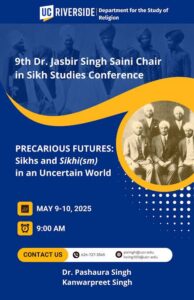 Placing recent history from the perspective of the Sikhs in the Kashmir valley, Dr Komal highlighted the precarious state of the Sikhs in the region at the Conference on Sikh Studies, organised by Dr Pashaura Singh, Distinguished Professor & Dr J. S. Saini Chair in Sikh and Punjabi Studies, University of California, Riverside, California, with able assistance from young scholars like Kanwarpreet Singh and others. The conference saw the participation of a wide range of scholars of various hues and shades of opinion.
Dr. Singh spoke on brief histography of Kashmiri Sikhs. She portrayed how the Sikhs of the valley faced everyday threat in last three decades. She narrated how a tiny minority remains invisible in these places. Bringing to the fore memories of how various Sikhs also faced everyday threat, she talked about the Chittisinghpora massacre and other recent incidents.
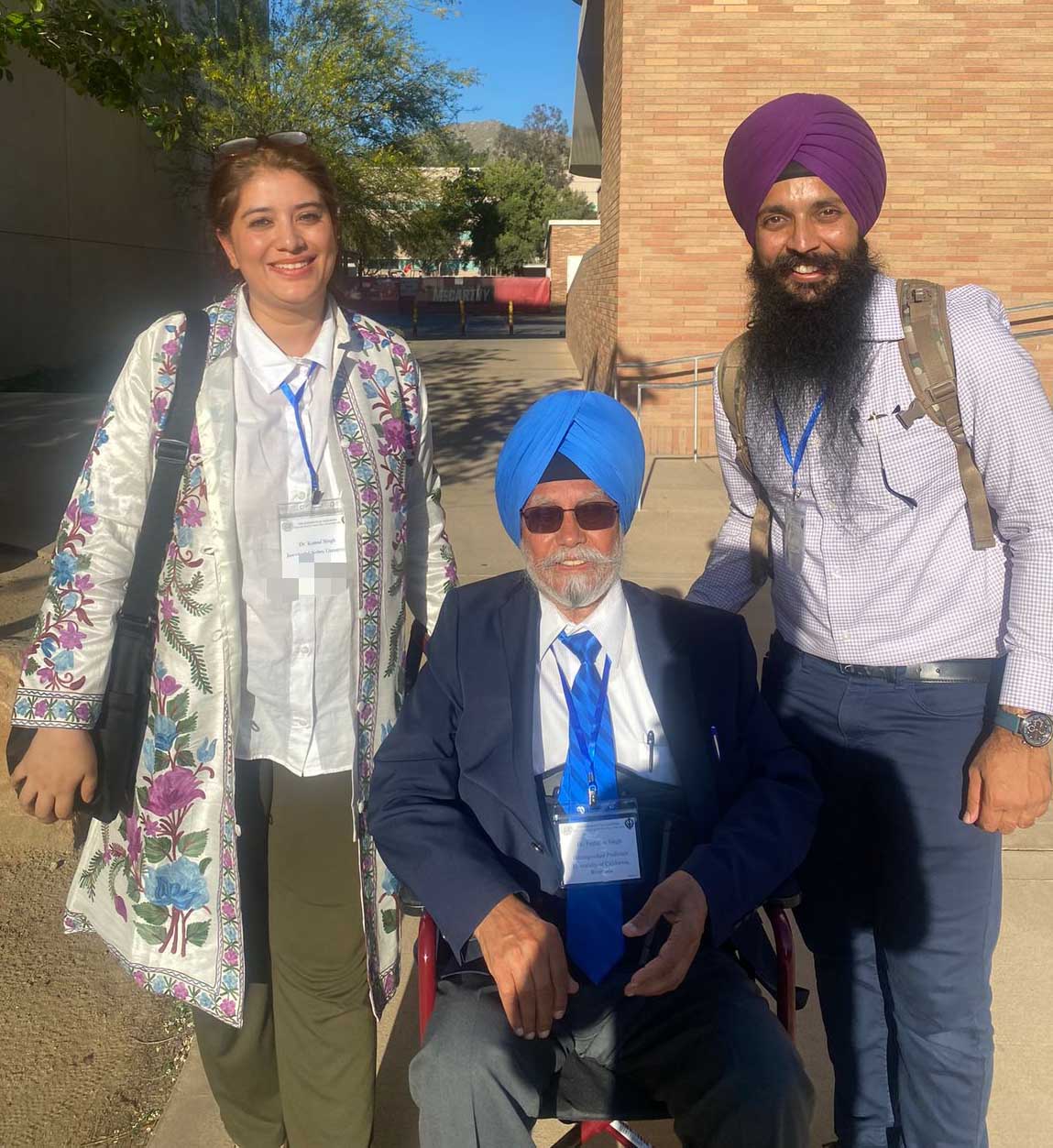
Dr Komal critiqued the consistent political, social, and economic marginalization of Sikhs in J & K. While they once formed a vibrant and distinct community, especially post-Partition, their numbers and influence have steadily dwindled.
She stressed that although everyday coexistence with the Muslim majority has been largely peaceful, it is time to bring to light the various nuances of Sikhs’ experiences in these regions. Sikhs are facing challenges which are largely ignored.
She stressed that although everyday coexistence with the Muslim majority has been largely peaceful, it is time to bring to light the various nuances of Sikhs’ experiences in these regions. Sikhs are facing challenges which are largely ignored.
A pivotal section of Dr. Komal’s address took note at the narrow geographical scope of global Sikh Studies. Too often, she argued, academia treats Sikhs outside Punjab as peripheral or derivative, ignoring regional contexts like that of Kashmir, where Sikhi took early root during the travels of Guru Nanak.
“To understand Sikhism only through a Punjab-centric lens is to distort and diminish its plural heritage.”
She emphasized that Guru Nanak’s egalitarian teachings resonated strongly in the Valley, where Sikh society notably lacks caste divisions to this day. The journeys of Guru Hargobind Sahib further deepened this footprint.
“To understand Sikhism only through a Punjab-centric lens, she contended, is to distort and diminish its plural heritage.”
Dr Komal issued a clarion call to scholars and institutions -in Punjab, in India and the world to broaden the field, acknowledge the cultural specificities of dispersed Sikh communities, and incorporate their voices and experiences into the global narrative. In this vein, she especially thanked Dr. Pashaura Singh for making the conference more inclusive by giving space to these voices.
While geopolitical tensions may eventually fade from the headlines, the deeper crises of identity, representation, and memory that Dr Komal JB Singh exposed will remain. In speaking truth to power from the margins of the Sikh world, she not only preserved a history in danger of being forgotten—she reminded us that the search for justice and belonging must never be deferred, even in the face of war.
 About Dr Komal Singh: Hailing from the picturesque yet conflict laden valley of Kashmir, educated at Jawaharlal Nehru University, New Delhi, where she completed her doctorate on the evolving Sikh identity in J & K. Dr. Komal is a fierce advocate for women’s rights and academic democratization. Her central academic and activist concern is the near-erasure of the Sikhs of Jammu and Kashmir from Sikh mainstream discourse.

 Share
Share
 Print
Print
